- Blue Church Book
- Posts
- How To Use Your Church As A Wellness “Cheat Code”
How To Use Your Church As A Wellness “Cheat Code”

Jerome Chandler
March 11, 2026
Shout out to recoverytrauma.com for a great graphic showing “fun ways to regulate your nervous system.”
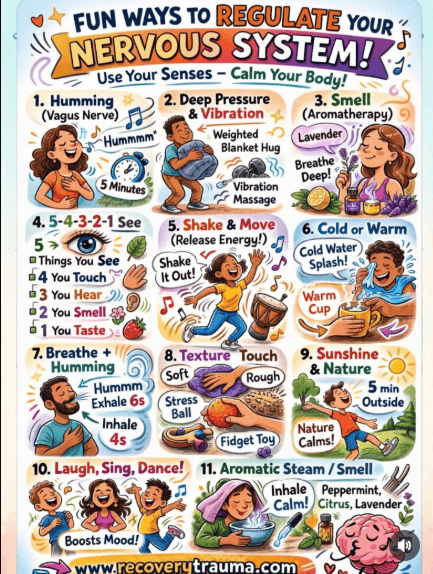
Modern psychology talks a lot about nervous system regulation now. Therapists and wellness experts recommend things like humming, breathing exercises, grounding techniques, movement, and sensory experiences to calm stress.
What’s interesting is how many of these practices have existed in church for centuries.
Looking at the chart, I noticed that six of the practices already happen naturally in traditional church life:
Humming / vocal vibration
Smell (aromatherapy)
5-4-3-2-1 sensory grounding
Shake & move
Breathing with humming or chanting
Laughing, singing, dancing
That’s a big overlap.
It raises an interesting possibility: church may be one of the oldest systems humans have developed for regulating the nervous system.
The Body Was Always Part of Worship
Modern faith discussions sometimes focus heavily on ideas, theology, or sermons.
But historically, worship engaged the entire body.
People didn’t just think about God.
They sang, knelt, stood, smelled incense, moved, chanted prayers, and celebrated together.
Those physical actions weren’t random traditions.
They were embodied practices that naturally calm stress and restore emotional balance.
Today neuroscience is simply giving language to what people practiced for centuries.
1. Chanting and Humming Calm the Vagus Nerve
The graphic highlights humming as a way to activate the vagus nerve, which helps shift the body from stress mode into calm.
In church, humming and vocal vibration happen constantly:
Chanted prayers
Liturgical responses
Singing hymns
Congregational chanting
The long exhale and vibration of the voice slows the heart rate and stabilizes breathing.
In other words, when people chant together in worship, they are doing a group nervous-system reset.
2. Incense Engages the Sense of Smell
The chart also highlights smell as a calming sensory input.
For centuries many churches have used incense during worship. The aroma isn’t just symbolic—it engages the limbic system, the part of the brain connected to memory and emotion.
Smell is one of the fastest ways to affect mood.
A consistent scent tied to prayer and sacred space can quickly signal to the brain:
You are safe.
You can slow down.
3. Worship Grounds the Senses
The 5-4-3-2-1 grounding technique asks people to notice what they see, hear, and feel in their environment.
Church naturally provides this sensory grounding:
You see candles and icons.
You hear music and voices.
You feel the presence of others nearby.
You taste communion.
You smell incense or bread.
The environment brings the mind out of racing thoughts and back into the present moment.
That’s exactly what grounding techniques are designed to do.
4. Movement Releases Stress
The graphic encourages shaking and movement to release nervous energy.
Church has always included physical expression:
Standing and sitting rhythms
Raising hands
Kneeling
Clapping
Dancing during praise breaks
These movements discharge tension the body carries.
Modern people often sit still all day absorbing stress. Worship breaks that pattern.
5. Breathing Rhythms Through Prayer
The chart also shows breathing exercises paired with humming.
Many traditional prayers follow natural breathing rhythms.
Slow, repeated phrases create a cycle of inhale, speak, exhale.
Examples include:
“Lord Jesus Christ, have mercy on me.”
“Kyrie eleison.”
The Lord’s Prayer.
These prayers slow breathing and stabilize the nervous system.
Again, what therapists now teach as breathing exercises has existed in liturgy for centuries.
6. Singing and Celebration Lift the Mood
The final overlap is joyful expression: laughing, singing, and dancing.
Congregational singing does something powerful.
It synchronizes breathing across a group.
It creates emotional unity.
It releases endorphins.
People leave worship feeling lighter not just because of the message, but because their biology shifted during the experience.
Joyful praise isn’t just spiritual expression.
It’s emotional regulation.
Church as a Wellness “Cheat Code”
Put all these elements together and something interesting emerges.
Church combines:
vocal vibration
breathing rhythm
sensory grounding
scent
movement
communal joy
All in one place.
And it happens weekly.
No wellness app required.
No expensive retreat necessary.
Just participation in worship.
Ancient Practices, Modern Language
None of this means church invented neuroscience.
But it does show that many spiritual practices developed over centuries happen to align remarkably well with what modern science says helps regulate the body.
Chanted prayer calms the nervous system.
Communal singing stabilizes breathing.
Movement releases stress.
Sacred environments ground the senses.
For generations people simply called this worship.
Today psychologists might call it regulation.
Either way, the result is the same.
Peace.